The online journal of Luke Dockery

Tag: Jesus (Page 2 of 15)

Enemies at the Table

Psalm 23 is famous and iconic: the image of Yahweh as a shepherd who provides all that we need, gives us rest and protection, and accompanies us through the darkest valleys of life. It is a comforting passage that emphasizes God’s love for us and the total sufficiency of His care and provision.

In Psalm 23.5, the metaphor seems to shift.[1] “You prepare a table before me in the presence of my enemies….” Certainly, this is still in keeping with the idea of God’s provision, but there is a heightened element with the allusion to enemies. Psalm 23 is subtitled “a Psalm of David,” and David was a character who certainly faced a series of enemies throughout his life, and had times of hardship where he experienced hunger and privation.

But what are we to make of the notion of feasting in front of our enemies? Is this a display of Yahweh’s support and vindication, perhaps coupled with a sense of triumph and gloating over our enemies? Many commentators think so. Here is a typical example:

“[The enemies] were compelled to look on and see how God provided for him. It was manifest that this was from God; it was a proof of the Divine favour; it furnished an assurance that he who had done this would never leave him to want. The friends of God are made to triumph in the very presence of their foes. Their enemies are compelled to see how he interposes in their behalf, how he provides for them, and how he defends them. Their final triumph in the day of judgment will be in the very presence of all their assembled enemies, for in their very presence he will pronounce the sentence which will make their eternal happiness sure….”[2]

I don’t necessarily have problems with this. Clearly, the picture here emphasizes God’s provision, and the provision itself signifies the vindication of David the Psalmist as a friend of God. And I confess that my initial, surface-level reading suggests at least a hint of gloating and triumphalism that I find a little distasteful—after all, don’t we teach our kids to be kind and humble in victory, rather than rubbing it in the faces of their opponents? Doesn’t Jesus tell us to love our enemies? Is it loving to gloat? Indeed, C.S. Lewis famously criticized this part of Psalm 23 on these grounds.[3]

With all of this in mind, I can’t help but wonder if there is more going on here—if only we had some additional instruction or example of dining in the presence of enemies that would bring some clarity to the situation! I don’t think the interpretation quoted above is incorrect, but I do wonder if it is incomplete.


Eating at tables was a large part of Jesus’s ministry. He performed His first miracle at a wedding in Cana, He told parables about feasts and banquets, and He instituted the Lord’s Supper in the context of a Passover meal.

He also dined frequently…with enemies. Some of those were enemies of established religious and moral order and respectability—Jesus repeatedly received criticism for eating with “tax collectors and sinners” (Matthew 9.10-17; Mark 2.15-22; Luke 5.29-39). In Luke 19, He famously visited the home of the diminutive chief tax collector Zacchaeus, and there He again was criticized for dining with a sinner. But the meal seems to have a transformative effect on Zacchaeus, who declares himself to be a changed man, and Jesus asserts that this is exactly the reason why He came—to seek and save the lost (Luke 19.10). Jesus had invited Himself over to Zacchaeus’s house, but it was in order to invite Zacchaeus to receive salvation.

Another time, Jesus dined at the home of Simon the Pharisee, a member of the sect that so frequently opposed Jesus (Luke 7.36-49). In other words, He dine with a different sort of enemy. While there, a “sinful woman” came and washed Jesus’s feet with her tears, dried them with her hair, and poured perfume on them. Simon is scandalized by this, and Jesus then tells him a parable to illustrate that it is those who recognize their need for forgiveness who are most motivated to love God in return. He is almost pleading with Simon to reevaluate the spiritual condition of His life.

And of course, on the last night before His crucifixion, Jesus spent the evening sharing a meal with His disciples. Of course, these were not Jesus’s enemies—at least, they were not supposed to be. But within a matter of hours, these friends would desert Him, and one of them, Judas Iscariot, would betray Him. But still, Jesus chooses to eat with these men, and He encourages them to love one another and to be unified.

Reflecting on all of this, it seems clear from Jesus’s own practice: He does not eat with enemies to humiliate them; rather, in humility, He eats with them to invite them into the fellowship of God and His people. “He eats to woo and win them, not to belittle or degrade.”[4]

In light of the practice of Jesus Himself, the Good Shepherd, it does make me rethink aspects of the interpretation of Psalm 23 mentioned above. As promised, God prepares a table before us in the presence of our enemies, but what if we dine in the presence of our enemies not to make our enemies become ashamed, but to make our enemies become our friends?

Indeed, this is the way of Jesus.

What if we dine in the presence of our enemies not to make our enemies become ashamed, but to make our enemies become our friends? Share on X

In this loose series of Scripture Reflections, I am sharing brief thoughts spurred on by my Bible reading. By way of reminder, my goal for these brief posts is two-fold:

(1) To remark on aspects of the biblical text that I find to be of interest that the reader may or may not have thought about previously.

(2) When possible, to point to the work and person of Jesus Christ. I believe the Bible is a unified story that points to Jesus, which means that He is frequently alluded to or foreshadowed in some way throughout the biblical canon.


[1] Scholars debate this, with some suggesting that the shepherd metaphor persists throughout the entire psalm. That doesn’t seem to be the case to me.

[2] Albert Barnes, Psalms I, Notes on the Old Testament (Grand Rapids, MI: Baker Book House, 1950), 213.

[3] C.S. Lewis, Reflection on the Psalms (San Francisco: HarperOne, 2017), 24-25: “The poet’s enjoyment of his present prosperity would not be complete unless those horrid Joneses (who used to look down their noses at him) were watching it all and hating it. This may not be so diabolical as the passages I have quoted above; but the pettiness and vulgarity of it, especially in such surroundings, are hard to endure.” I think Lewis misses the mark here, but I get where he is coming from. 

[4] David Gibson, “Why C.S. Lewis Was Wrong about Psalm 23,” Crossway, October 27, 2023, https://www.crossway.org/articles/why-c-s-lewis-was-wrong-about-psalm-23/.
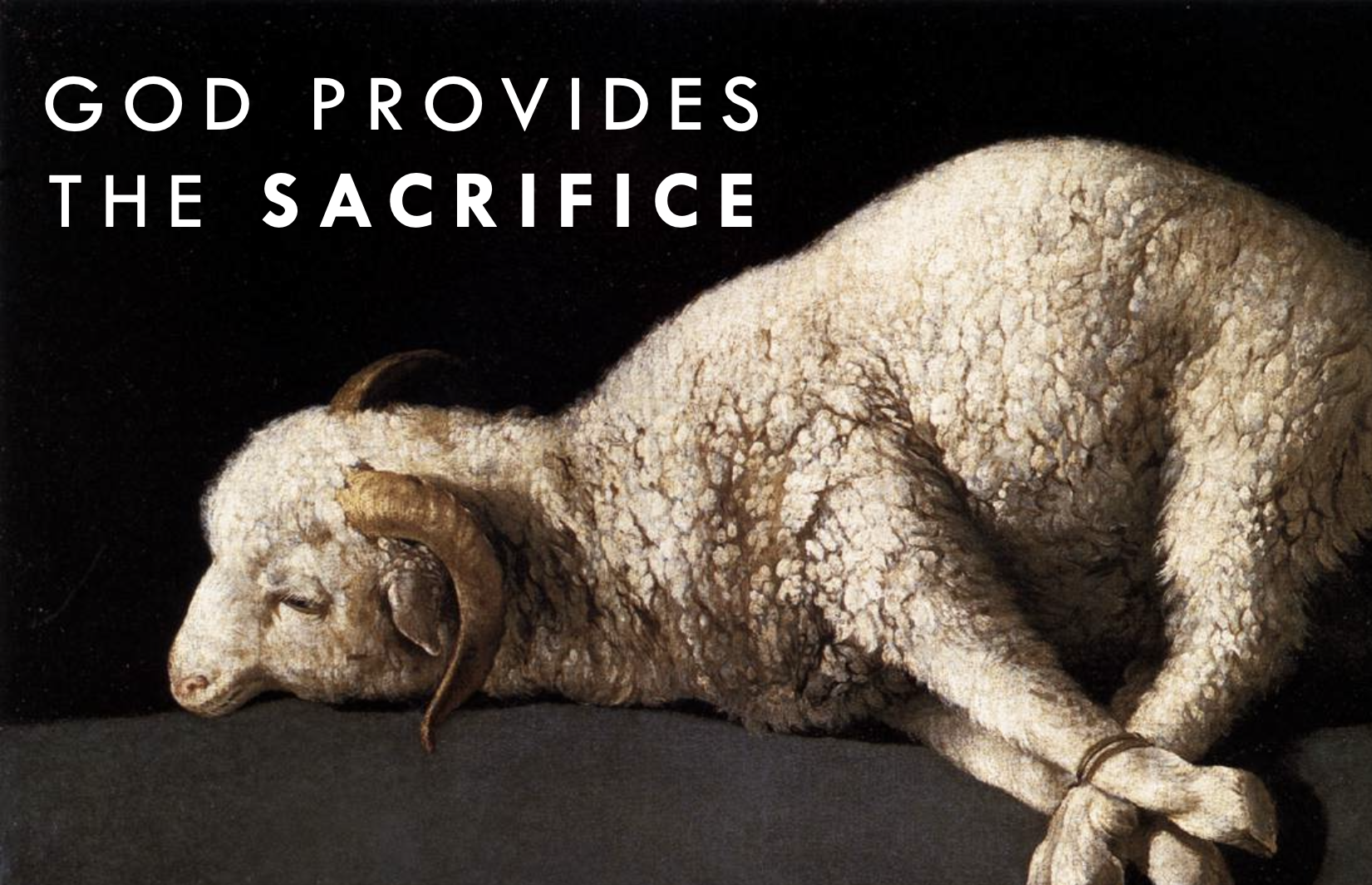
God Provides the Sacrifice

Genesis 22 is one of the most moving and haunting chapters of Scripture; it recounts the story of Akedah, or the Binding of Isaac, as Abraham is commanded to take his son and offer him as a sacrifice on an altar on Mount Moriah.

1 After these things God tested Abraham and said to him, “Abraham!” And he said, “Here I am.” 2 He said, “Take your son, your only son Isaac, whom you love, and go to the land of Moriah, and offer him there as a burnt offering on one of the mountains of which I shall tell you.”

(Genesis 22.1-2)

This must have been an agonizing task for Abraham, as he is called to offer his beloved son, the one for whom he had so long waited, the one on whom all his future hopes rested. The narrative is told slowly, with painstaking detail, heightening the tension and the growing sense of tragedy.

3 So Abraham rose early in the morning, saddled his donkey, and took two of his young men with him, and his son Isaac. And he cut the wood for the burnt offering and arose and went to the place of which God had told him. 4 On the third day Abraham lifted up his eyes and saw the place from afar. 5 Then Abraham said to his young men, “Stay here with the donkey; I and the boy will go over there and worship and come again to you.” 6 And Abraham took the wood of the burnt offering and laid it on Isaac his son. And he took in his hand the fire and the knife. So they went both of them together. 7 And Isaac said to his father Abraham, “My father!” And he said, “Here I am, my son.” He said, “Behold, the fire and the wood, but where is the lamb for a burnt offering?” 8 Abraham said, “God will provide for himself the lamb for a burnt offering, my son.” So they went both of them together.

9 When they came to the place of which God had told him, Abraham built the altar there and laid the wood in order and bound Isaac his son and laid him on the altar, on top of the wood. 10 Then Abraham reached out his hand and took the knife to slaughter his son. 11 But the angel of the LORD called to him from heaven and said, “Abraham, Abraham!” And he said, “Here I am.” 12 He said, “Do not lay your hand on the boy or do anything to him, for now I know that you fear God, seeing you have not withheld your son, your only son, from me.” 13 And Abraham lifted up his eyes and looked, and behold, behind him was a ram, caught in a thicket by his horns. And Abraham went and took the ram and offered it up as a burnt offering instead of his son. 14 So Abraham called the name of that place, “The LORD will provide”; as it is said to this day, “On the mount of the LORD it shall be provided.”

(Genesis 22.3-14)

But, as tragic as this story could have been, things turn out okay: Isaac is not offered as a sacrifice because God steps in and provides another sacrifice, a ram that had been caught in a thicket. The father did not have to witness the death of his beloved son.

Abraham looks around and calls the name of that place, “The LORD will provide.”


We fast forward hundreds of years to a very similar mountain[1] on another altar of sorts, where Jesus, the beloved Son, the One for whom the world had so long waited, the One on whom all future hopes rested, hangs on a cross.

But this time, there is no alternative sacrifice. The Father does witness the death of His beloved Son because Jesus Himself is the alternative. The LORD did provide, and He provided the Lamb slain from the foundation of the world…to take the place of Isaac…to take the place of each of us.

Unlike with Isaac, this time, there is no alternative sacrifice. The Father does witness the death of His beloved Son because Jesus Himself is the alternative. Share on X

God provides the sacrifice because God Himself is the sacrifice, absorbing the darkness of the world into Himself.


In this loose series of Scripture Reflections, I am sharing brief thoughts spurred on by my Bible reading. By way of reminder, my goal for these brief posts is two-fold:

(1) To remark on aspects of the biblical text that I find to be of interest that the reader may or may not have thought about previously.

(2) When possible, to point to the work and person of Jesus Christ. I believe the Bible is a unified story that points to Jesus, which means that He is frequently alluded to or foreshadowed in some way throughout the biblical canon.


[1] Scholars debate the relative locations of Mount Moriah and Golgotha, but many believe them to be the same place.

The Department of Government Efficiency…and The Parable of the Weeds

I am generally hesitant to comment on political matters, partially because politics can be so divisive, and partially because I am generally not informed enough to do so with any credibility. On the other hand, I am all about discussing Scripture, and also discerning how the wisdom of Scripture can be brought to bear on the challenging issues of life. Thus, this post.

Over the last few weeks, the new Department of Government Efficiency (DOGE) has been rifling through the drawers of the federal government, seeking to identify and eliminate waste, significantly by cutting funding or eliminating jobs. We live in a wildly polarized society, so I shouldn’t be surprised by the wide gulf between the different responses I have observed to DOGE’s activities so far. And yet, I am: on social media, some of my friends are hailing all of this as a much-needed and valuable work, while others identify it as the onset of fascism and the harbinger of the downfall of our nation.

And all I can think about is Jesus’s Parable of the Weeds.


Found in Matthew 13, the Parable of the Weeds is one of Jesus’s many parables that focuses on the nature of God’s kingdom:

24 He put another parable before them, saying, “The kingdom of heaven may be compared to a man who sowed good seed in his field, 25 but while his men were sleeping, his enemy came and sowed weeds among the wheat and went away. 26 So when the plants came up and bore grain, then the weeds appeared also. 27 And the servants of the master of the house came and said to him, ‘Master, did you not sow good seed in your field? How then does it have weeds?’ 28 He said to them, ‘An enemy has done this.’ So the servants said to him, ‘Then do you want us to go and gather them?’ 29 But he said, ‘No, lest in gathering the weeds you root up the wheat along with them. 30 Let both grow together until the harvest, and at harvest time I will tell the reapers, “Gather the weeds first and bind them in bundles to be burned, but gather the wheat into my barn.”’”

36 Then he left the crowds and went into the house. And his disciples came to him, saying, “Explain to us the parable of the weeds of the field.” 37 He answered, “The one who sows the good seed is the Son of Man. 38 The field is the world, and the good seed is the sons of the kingdom. The weeds are the sons of the evil one, 39 and the enemy who sowed them is the devil. The harvest is the end of the age, and the reapers are angels. 40 Just as the weeds are gathered and burned with fire, so will it be at the end of the age. 41 The Son of Man will send his angels, and they will gather out of his kingdom all causes of sin and all law-breakers, 42 and throw them into the fiery furnace. In that place there will be weeping and gnashing of teeth. 43 Then the righteous will shine like the sun in the kingdom of their Father. He who has ears, let him hear.”

(Matthew 13.24-30; 36-43)

This is a parable about the kingdom of God growing in a hostile environment and some of the realities that come with that. A man sows seed in a field, but then an enemy comes and secretly sows weeds among the good seed. When the plants start to grow, it becomes apparent what has happened, and the servants, wanting to be helpful, ask their master if they should pull the weeds. The master, though acknowledging the existence of the weeds and the problem they represent, tells his servants not to pull up the weeds because they might cause damage to the wheat when they do so. In other words, the effort to root out the bad can actively harm the good. 

Sometimes the effort to root out the bad can actively harm the good. Share on X

Jesus goes on to explain the spiritual significance of this parable and there are some really important lessons there that I have discussed elsewhere.[1] I don’t want to pretend or suggest that this parable is somehow about what we see going on in our current political landscape, but I do think there is a principle here that applies.

I don’t think any fair-minded person would deny that the U.S. federal government operates on a massive scale, and that in such a vast and complicated structure, there is bound to be a significant amount of inefficiency and even incompetence. Put differently, there really are weeds in the field. But that doesn’t mean that the wise course of action is to rush in and start indiscriminately yanking up the weeds, because you likely are going to pull out a lot of good plants as well.

From my perspective, this is what DOGE has done. I know an increasing number of good, faithful civil servants who are losing employment because of sweeping cuts, as well as good, worthwhile programs that are being defunded. None of this is to suggest that the federal government is efficient, or that no cuts should be made—there really are weeds in the field! But it does suggest that when you have such a vast and complicated network of employees and programs with problems that have accumulated over decades, you’re probably not going to be able to wisely solve the problem within a few weeks.


[1] Jeremy Myers & Luke Dockery, Kingdom Parables: A Study of the Stories of Jesus (Springdale, AR, Deeper Youth Ministry, 2024), 29-31.

2024 Blog Review

I think reflection is a healthy practice, and I like to end each year by looking back and reviewing my year of blogging here at The Doc File (Here are some previous reviews from 2023, 2022, 2021, 2020, 2019, 2018, 2016, 2015, and 2012).

Overview

This past year—especially the first three-fourths of it—was extremely busy for me, and that negatively impacted how often I was able to write in this space. I will end the year with 19 posts, which is the fewest since 2019, when I wrote only 17 times. A goal for the new year is to prioritize writing more than I did last year.

Top Posts

By traffic totals, here are my most-read posts during 2024 (posts in bold were actually written this year):

  1. A New Heaven & A New Earth Series, April 29, 2020
  2. Reading in 2023, January 9, 2024
  3. A New Heaven & A New Earth: What the Bible Teaches about Eternity, April 9, 2020
  4. 2024 Harding University Lectureship Recap, December 19, 2024
  5. Jesus, Christmas, and Hanukkah, December 18, 2015
  6. Ranking Walt Disney World Parks, March 22, 2024
  7. A Great Week of Youth Ministry, March 2, 2024
  8. Politics from a Christian Perspective: Introduction, October 20, 2020
  9. A New Heaven & A New Earth Part 5: “Problem” Texts—John 14.1-3, May 8, 2020
  10. A New Heaven & A New Earth Part 6: The Redemption of All Things, May 14, 2020

Four of the top posts from 2023 were actually written this year, and it is always good to see new content get some traction:

  • I have developed certain traditions of posts that I write each year, and these have developed somewhat of a following over time. Reading in 2023 reviewed the books I read over the previous year, along with my favorites for 2023 (the 2024 version of this post is right around the corner!). I also review Harding’s Lectureship each year, and this year’s post got some traction, most likely because it discussed some controversy.
  • At the end of 2023, my family got to take an awesome trip to Disney World in Florida, and Ranking Walt Disney World Parks was a fun post that helped me to relive some of those memories and preserve my definitive rankings of the different parks.
  • A Great Week of Youth Ministry was one of my favorite posts to write, as it helped me reflect upon and process a particularly full and meaningful week of youth ministry and bask in the blessings of this wonderful vocation to which I have been called.

At the same time, part of the reason for preserving over 15 years of posts on this site is for people to be able to go back and read things they missed, and I am always gratified when older posts are read by new people. The series I wrote in 2020 on renewed eschatology continues to get a lot of views (taking four of the top ten spots), as does my post on Jesus, Christmas, and Hanukkah. Additionally, during this year’s election season, I reshared my series on Politics from a Christian Perspective, which garnered a decent amount of attention.

Blog Series

I didn’t do as much with ongoing Blog Series in 2024, but I did continue to contribute to Scripture Reflections. I added six more posts to this ongoing series over the past year:

This brings the series to a total to 26 posts. I plan to continue adding to this indefinitely, and suspect that it will eventually turn into a book project.


So, that was The Doc File in 2024! As mentioned above, it was a somewhat modest year for my blog, and I hope to write more here in 2025, and to make some adjustments to my regular schedule to help with that. This has become a formative spiritual discipline for me to process my thoughts here over the years, and so I want to intentionally support that practice. As always, I am thankful for your readership and support!

Linking Heaven and Earth: Jacob’s Ladder and Jesus

The Gospel of John is one of my favorite books in the Bible, and one of its special characteristics is that, more than any other, it emphasizes the divinity of Jesus. This is done over and over again and in many different ways, but one interesting way it does so is through an allusion in John 1.47-51.

Here, Jesus calls Philip to follow Him, and then Philip subsequently goes and recruits a man named Nathanael as well. Nathanael is skeptical that Jesus, from the lowly town of Nazareth, could be the Messiah whom Moses and the prophets had proclaimed, and so Philip invites him to go and see Jesus for himself:

47 Jesus saw Nathanael coming toward him and said of him, “Behold, an Israelite indeed, in whom there is no deceit!” 48 Nathanael said to him, “How do you know me?” Jesus answered him, “Before Philip called you, when you were under the fig tree, I saw you.” 49 Nathanael answered him, “Rabbi, you are the Son of God! You are the King of Israel!’’

(John 1.47-49)

Although Nathanael was really impressed that Jesus knew what he had been doing before they had even met, Jesus basically told him that he hadn’t seen anything yet:

50 Jesus answered him, “Because I said to you, ‘I saw you under the fig tree,’ do you believe? You will see greater things than these.” 51 And he said to him, “Truly, truly, I say to you, you will see heaven opened, and the angels of God ascending and descending on the Son of Man.”

(John 1.50-51)

If you know are familiar with the narratives of Genesis, then the imagery of heaven opening up and angels ascending and descending is probably very familiar to you, and it almost certainly would have been familiar to Nathanael. It is most likely an allusion to Genesis 28, where Jacob, while on a journey to Haran to stay with his uncle Laban (and ultimately get married), stops to sleep for the night, using a stone for a pillow:

12 And he dreamed, and behold, there was a ladder set up on the earth, and the top of it reached to heaven. And behold, the angels of God were ascending and descending on it!

(Genesis 28.12)

At the top of the ladder, the LORD appears, and basically reaffirms to Jacob the same promises that He had previously made to Abraham and Isaac. When Jacob awakens from his sleep, he realizes that something significant has happened:

16b “‘Surely the LORD is in this place, and I did not know it.’ And he was afraid and said, ‘How awesome is this place! This is none other than the house of God, and this is the gate of heaven.’”

(Genesis 28.16b)

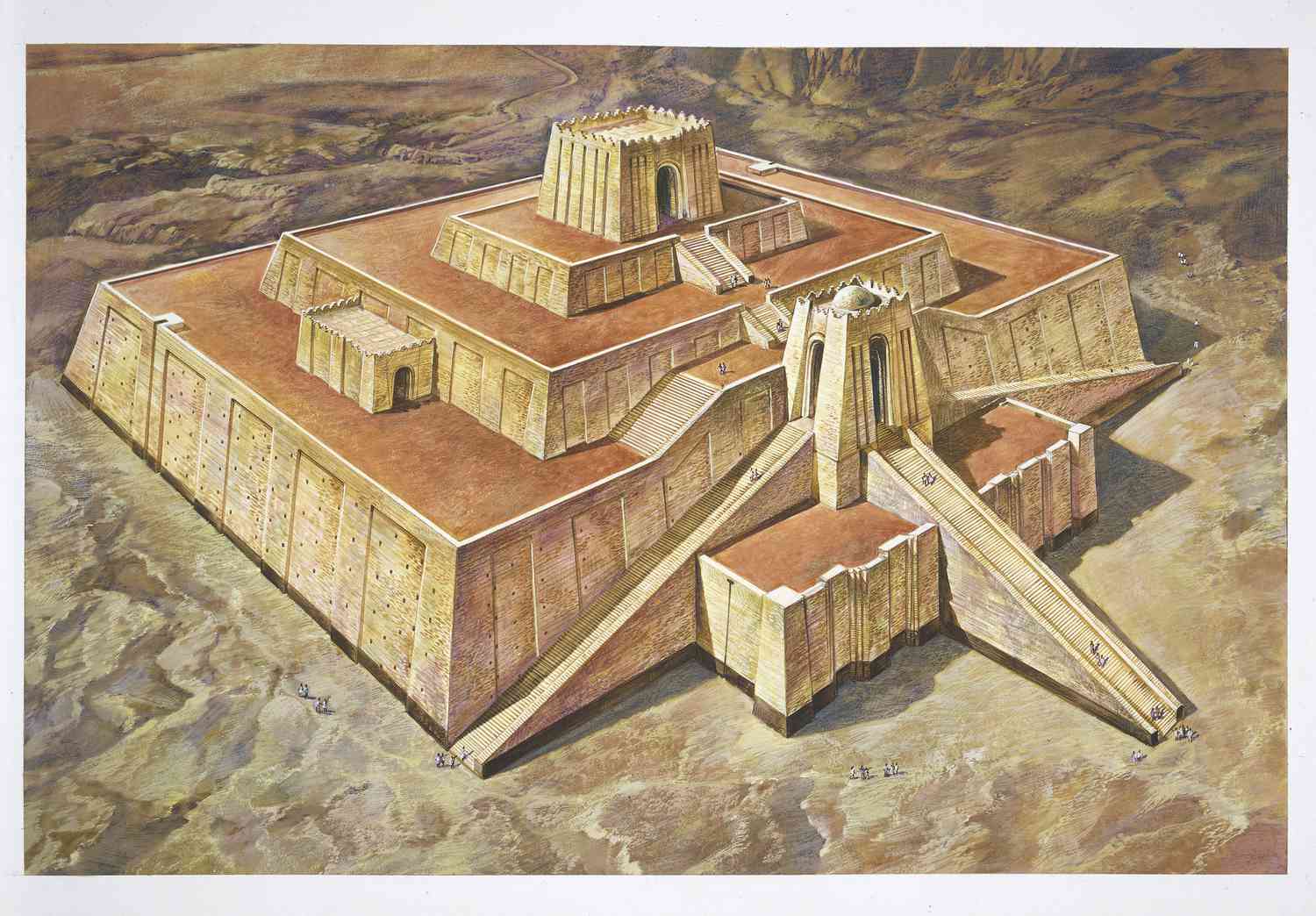
The next morning Jacob takes his stone pillow and sets it up as a monument, naming the place “Bethel,” which means “house of God.” This approximates temple language, and likely gives us a better picture of what Jacob’s dream looked like. Scholars suggest that what Jacob saw was not a “ladder” as we think of it, but a ziggurat, a Mesopotamian step-pyramid/temple.[1] In the cosmology of the ancient world, temples were overlapping spaces that linked heaven and earth, God’s space and human space. Ziggurats, in particular, had extensive staircases that were designed to connect divine space with human space and enable gods to “come down” to their temples.

Ancient ziggurats had extensive steps, ideal for the ascending and descending that Jacob witnessed in his dream.

As already suggested above, the language of Genesis 28.12 and John 1.51 is so similar that it seems clear that Jesus was intentionally alluding to Jacob’s dream. So what does the connection mean?

In Jacob’s dream, a “ladder” connected earth (where Jacob is) and heaven (where the LORD is), and angels ascend and descend upon the ladder. Jacob is awed by what he sees. In John 1, Jesus paints a similar picture for Nathanael: the heavens open, and the angels of God are ascending and descending. The difference is that now, instead of ascending and descending upon a ladder, the angels are doing so upon the Son of Man—Jesus Himself.

The implication is that Jesus is the new “ladder”, the New Bethel, the new house of God. 

This is the greater thing that Nathanael will get to see: just as Bethel was the place where the heavens were connected to earth, so Jesus is the medium through which heaven and earth, God and man, are brought together.[2]

Just as Bethel was the place where the heavens were connected to earth, so Jesus is the medium through which heaven and earth, God and man, are brought together. Share on X

The Gospel of John affirms here—as it does elsewhere—that Jesus was absolutely unique. As the Son of God, His roots were in heaven, but as a human, He also put down roots on earth. This is the wonderful mystery of the Incarnation, the Word becoming flesh, and is what enabled Him to carry out the work of reconciling creation to its Creator (cf. 2 Corinthians 5.18-19).


In this loose series of Scripture Reflections, I am sharing brief thoughts spurred on by my Bible reading. By way of reminder, my goal for these brief posts is two-fold:

(1) To remark on aspects of the biblical text that I find to be of interest that the reader may or may not have thought about previously.

(2) When possible, to point to the work and person of Jesus Christ. I believe the Bible is a unified story that points to Jesus, which means that He is frequently alluded to or foreshadowed in some way throughout the biblical canon.


[1] For example, see Scott Aniol, “What Was Jacob’s Ladder?”, By the Rivers of Babylon, October 9, 2024.

[2] F. F. Bruce, The Gospel of John, (Grand Rapids: Eerdmans, 1983), 62: “In this application of Jacob’s vision, however, the union between earth and heaven is effected by the Son of Man: he is the mediator between God and the human race.”

« Older posts Newer posts »

© 2026 The Doc File

Theme by Anders Noren — Up ↑