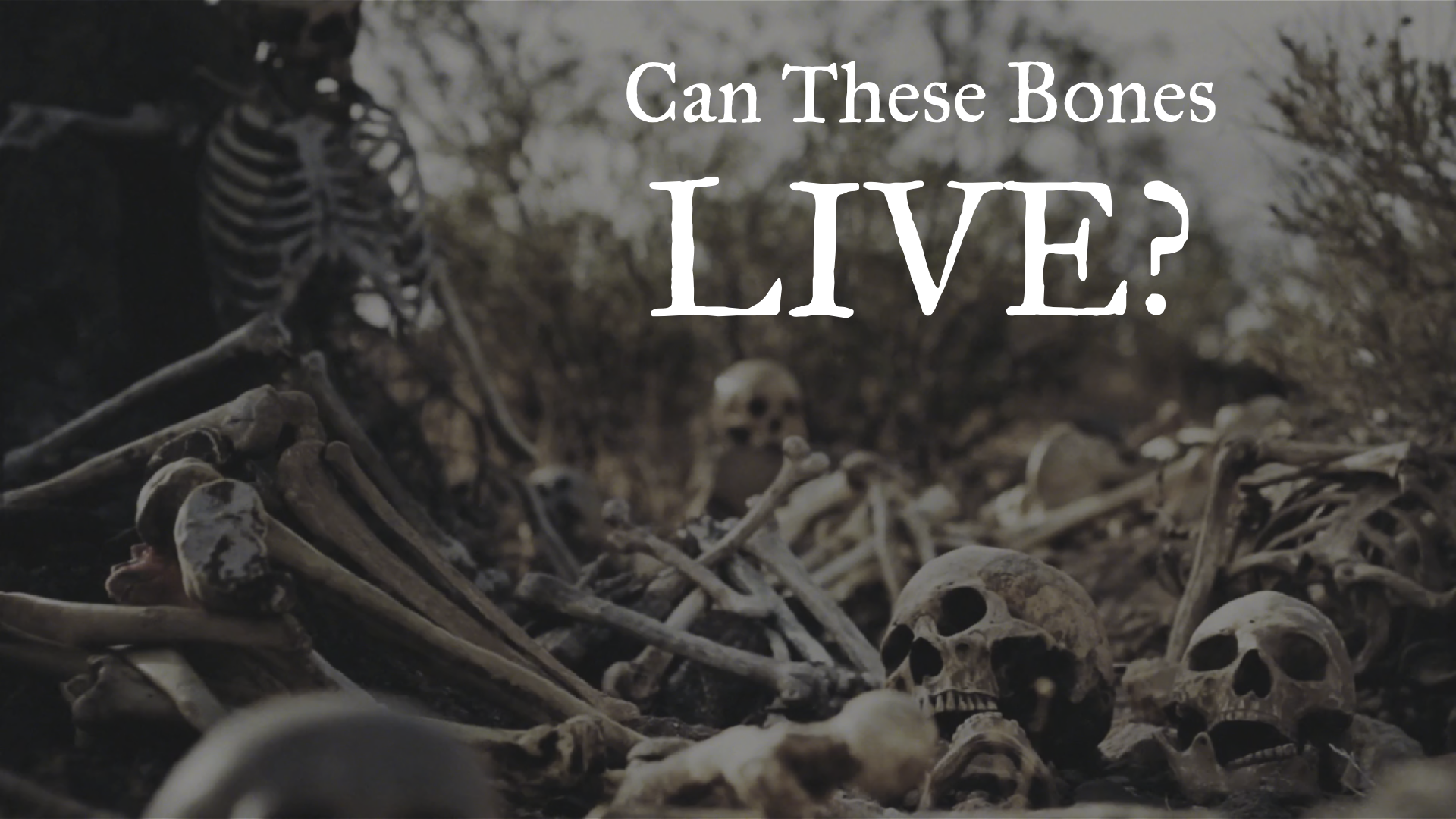
Ezekiel 37 recounts what must be one of the creepiest stories in the entire Bible:
1 The hand of the Lord was upon me, and he brought me out in the Spirit of the Lord and set me down in the middle of the valley; it was full of bones. 2 And he led me around among them, and behold, there were very many on the surface of the valley, and behold, they were very dry. 3 And he said to me, “Son of man, can these bones live?” And I answered, “O Lord God, you know.” 4 Then he said to me, “Prophesy over these bones, and say to them, O dry bones, hear the word of the Lord. 5 Thus says the Lord God to these bones: Behold, I will cause breath to enter you, and you shall live. 6 And I will lay sinews upon you, and will cause flesh to come upon you, and cover you with skin, and put breath in you, and you shall live, and you shall know that I am the Lord.”
7 So I prophesied as I was commanded. And as I prophesied, there was a sound, and behold, a rattling, and the bones came together, bone to its bone. 8 And I looked, and behold, there were sinews on them, and flesh had come upon them, and skin had covered them. But there was no breath in them. 9 Then he said to me, “Prophesy to the breath; prophesy, son of man, and say to the breath, Thus says the Lord God: Come from the four winds, O breath, and breathe on these slain, that they may live.” 10 So I prophesied as he commanded me, and the breath came into them, and they lived and stood on their feet, an exceedingly great army.
11 Then he said to me, “Son of man, these bones are the whole house of Israel. Behold, they say, ‘Our bones are dried up, and our hope is lost; we are indeed cut off.’ 12 Therefore prophesy, and say to them, Thus says the Lord God: Behold, I will open your graves and raise you from your graves, O my people. And I will bring you into the land of Israel. 13 And you shall know that I am the Lord, when I open your graves, and raise you from your graves, O my people. 14 And I will put my Spirit within you, and you shall live, and I will place you in your own land. Then you shall know that I am the Lord; I have spoken, and I will do it, declares the Lord.”
(Ezekiel 37.1-14)
This is a crazy story, but it’s actually quite fitting for Ezekiel’s crazy life: taken into captivity in Babylon, Ezekiel experiences frequent visions, is called to radical forms of preaching to a people who he knows will not listen or repent, and suffers great personal loss. And then, after all this, Ezekiel gets the news that Jerusalem has fallen—Babylon has conquered the city and destroyed the Temple.
This is the context for the creepy story in Ezekiel 37: Ezekiel is out in the middle of nowhere in a valley filled with dry, scorched bones. He is commanded to preach to them (which, by this point, probably doesn’t even seem that strange to him!) and the bones begin to rattle around and then come together, joined by ligaments, tendons, and muscles, and are covered with flesh. Then the breath of the wind comes upon them and they become living people.
These dry bones in Ezekiel 37 are a metaphor for Israel’s spiritual state: exile and death, yes, but God’s Spirit is coming to bring His people back to life. It recalls the story in Genesis 2 where God creates humans out of dirt and breathes life into them with His Spirit. And the rest of the book of Ezekiel continues with a message of hope. Earlier, judgment was the emphasis: the people have been unfaithful, they haven’t loved God and other people, they won’t listen to correction, they have hard hearts of stone, and there will be consequences for their wickedness: Babylon is going to conquer them.
But now there is an emphasis on hope, because exile is not the end. The dry bones can live again. God is going to restore Israel, a new Israel with a new heart, He’s going to defeat evil in the nations, and He’s actually going to redeem all of creation as well. The book of Ezekiel ends with a vision of a new temple with a stream flowing out from it that becomes a mighty river that flows into the Dead Sea Valley—a desert place of barrenness where nothing can live in the water because it’s so salty—and it turns it into a lush paradise, a new garden of Eden called, “The Lord is there.”
And that’s how Ezekiel ends.
This story of dry bones coming to life in Ezekiel 37, a story of judgment and hope, exile and return, death and new life, is really a powerful summary of the whole story of the Bible. This is the story of Scripture over and over again. God asks Ezekiel, “Son of man, can these bones live?” and the answer is a resounding Yes!
- Yes, when humans rebel and get kicked out of the garden, God promises to enact a plan to bring them back!
- Yes, there is life and freedom after slavery in Egypt!
- Yes, there is a return after exile in Babylon!
- Yes, after the sinless Messiah is betrayed, arrested, beaten, and crucified, there is an empty tomb and a resurrected life!
And this isn’t just the story of the Bible, it’s our story too. Yours and mine. “Son of man, can these bones live?” Yes!
- Can a damaged friendship, a broken relationship, a betrayed marriage—can these come back to life? Is there any hope? Can these bones live? With God’s help, yes they can!
- Can a church that is beset by controversy, quarreling, or just indifference, a church that dwindles and shrinks—is there any hope for such a church? Can these bones live? Yes, they can!
- Can the sin that keeps you in bondage, the sin that enslaves you, that you say over and over that you won’t do it again and yet you keep coming back to it—can you ever be free of that? Can these bones live? Yes, they can!
- As we go through this life filled with difficulties and delights, and as we march relentlessly toward the death that awaits all of us…is there anything for us beyond the grave? Can these bones live? Quite literally, yes they can!
Our story connects to God’s story. That’s part of what Paul talks about in Romans 6. There, he describes how when we are baptized into Christ, we die to sin. The old person we were who was enslaved to sin dies, and a new creation replaces that. This has implications for the present because right now, in our lives as parts of God’s new creation, we live differently, set free from sin. But it also has implications for the future because “if we have been united with Christ in a death like his, we shall certainly be united with Him in a resurrection like his” (Romans 6.5).
Christ died and was placed in a tomb, and then rose again to new life, not as some sort of spirit or ghost floating around, but with a new body. After His resurrection, Jesus specifically says that He’s not a ghost, that He has flesh and…bones.
One day you and I, if Jesus doesn’t return before then, will die. It may happen soon in a surprising way, or it may happen many years from now as our bodies age and weaken, we grow sick and feeble, and we pass away. Then our bodies will be buried in the ground and slowly begin to decompose. And eventually, we will be nothing more than dry bones.
Son of man, can these bones live?
If you belong to Jesus, the answer is Yes! Our bodies, which were “planted” in the ground corruptible and perishable, will be raised incorruptible and imperishable (1 Corinthians 15.42-44). God’s Spirit will breathe into them, and we will be alive again, suitable and prepared, ready for an eternity in God’s presence, in that new garden of Eden paradise that Ezekiel talked about: “The Lord is there.”
Son of man, can these bones live? The answer is Yes! This is God’s story, and it can be our story too.
 In this loose series of Scripture Reflections, I am sharing brief thoughts spurred on by my Bible reading. By way of reminder, my goal for these brief posts is two-fold:
(1) To remark on aspects of the biblical text that I find to be of interest that the reader may or may not have thought about previously.
(2) When possible, to point to the work and person of Jesus Christ. I believe the Bible is a unified story that points to Jesus, which means that He is frequently alluded to or foreshadowed in some way throughout the biblical canon.







