The online journal of Luke Dockery

Tag: Scripture Reflections (Page 5 of 7)

2022 Blog Review

I like to end the year by looking back and reviewing my year of blogging here at The Doc File (Here are some previous reviews from 2021, 2020, 2019, 2018, 2016, 2015, and 2012).

Overview

As I mentioned recently, I have been busy with a lot of different projects in 2022, and as a result, my time to write here at The Doc File has been limited. I went from 51 posts in 2020, to 28 in 2021, to only 20 posts in 2022. As a general rule, when you write less, you have less blog traffic, and that was certainly the case for me in 2022.

Top Posts

By traffic totals, here are my most-read posts during 2022:

  1. About That Graphic Going Around, April 4, 2022
  2. A New Heaven & A New Earth Series, April 29, 2020
  3. The Doctrine of Unity, September 7, 2022
  4. A New Heaven & A New Earth: What the Bible Teaches about Eternity, April 9, 2020
  5. The Faith of American Teenagers, February 9, 2022
  6. Staying In Ministry (My “Keep Going” File), May 20, 2022
  7. Reading in 2021, January 5, 2022
  8. Faith & Deconstruction, October 26, 2022
  9. A New Heaven & A New Earth Part 3: “Problem” Texts—1 Thessalonians 4.13-18, April 23, 2020
  10. My Kingdom is Not From This World, July 6, 2022

Very different from last year’s results, seven of my top ten posts of the year were actually written this year. The series I wrote in 2020 on renewed eschatology continues to get a lot of views, but I was pleased by how well several posts did this year (I may not have written much this year, but apparently people were interested in much of what I did write!).

Several of this year’s top posts were related to youth ministry either directly or tangentially:

  • About That Graphic Going Around was my most popular of the year, and was in response to a graphic I saw shared all over Facebook that I thought was inaccurate in claims it was making about passing faith on to the next generation (though I was very sympathetic to what it was trying to do).
  • The Faith of American Teenagers unpacks the research of the National Study on Youth and Religion (NSYR) and discusses Christian Moralistic Therapeutic Deism. 
  • Staying in Ministry (My “Keep Going” File) reflected on the mass exodus of those who are getting out of congregational ministry, my own struggles with ministry at times (2022 was a tough year for me), and a practice that has helped me to stay.
  • Faith & Deconstruction was a response to the widespread cultural phenomenon of deconstruction and reflected my efforts to listen well to those who have experienced this and explain how this term is actually being used to describe several different processes.

I was pleased to see that The Doctrine of Unity received a lot of attention, as I think it is an important and neglected topic; it was part of my ongoing Scripture Reflections series. My yearly post on my top books of the year is usually fairly popular, and Reading in 2021 was no exception. And, finally, My Kingdom is Not From This World was a brief post, but one that I liked because it touched on an important biblical topic—how Jesus’s kingdom relates to this “world”.

Blog Series

I didn’t do a lot with Blog Series in 2022, but I did conclude one series and continue another:

Learning from the Apostolic Fathers: I wrote the majority of this series back in 2021, but I did finish it in 2022 with a post on The Didache. 
This was a beneficial project for me, as I had not delved deeply into the writings of the Early Church Fathers before.

Scripture Reflections: I added four more posts to this ongoing series in 2022 (Jethro’s Wise Advice, “Tell His Disciples…and Peter”, The Doctrine of Unity, and Seeking a Homeland) bringing the total to 15 posts. I plan to continue adding to this indefinitely.


So, that was The Doc File in 2022! I plan to continue to write in 2023 (hopefully more frequently). Writing my thoughts in this space has been very helpful for me over the years, and from your kind comments, I know it is helpful to many others as well. I am thankful for your readership and support!
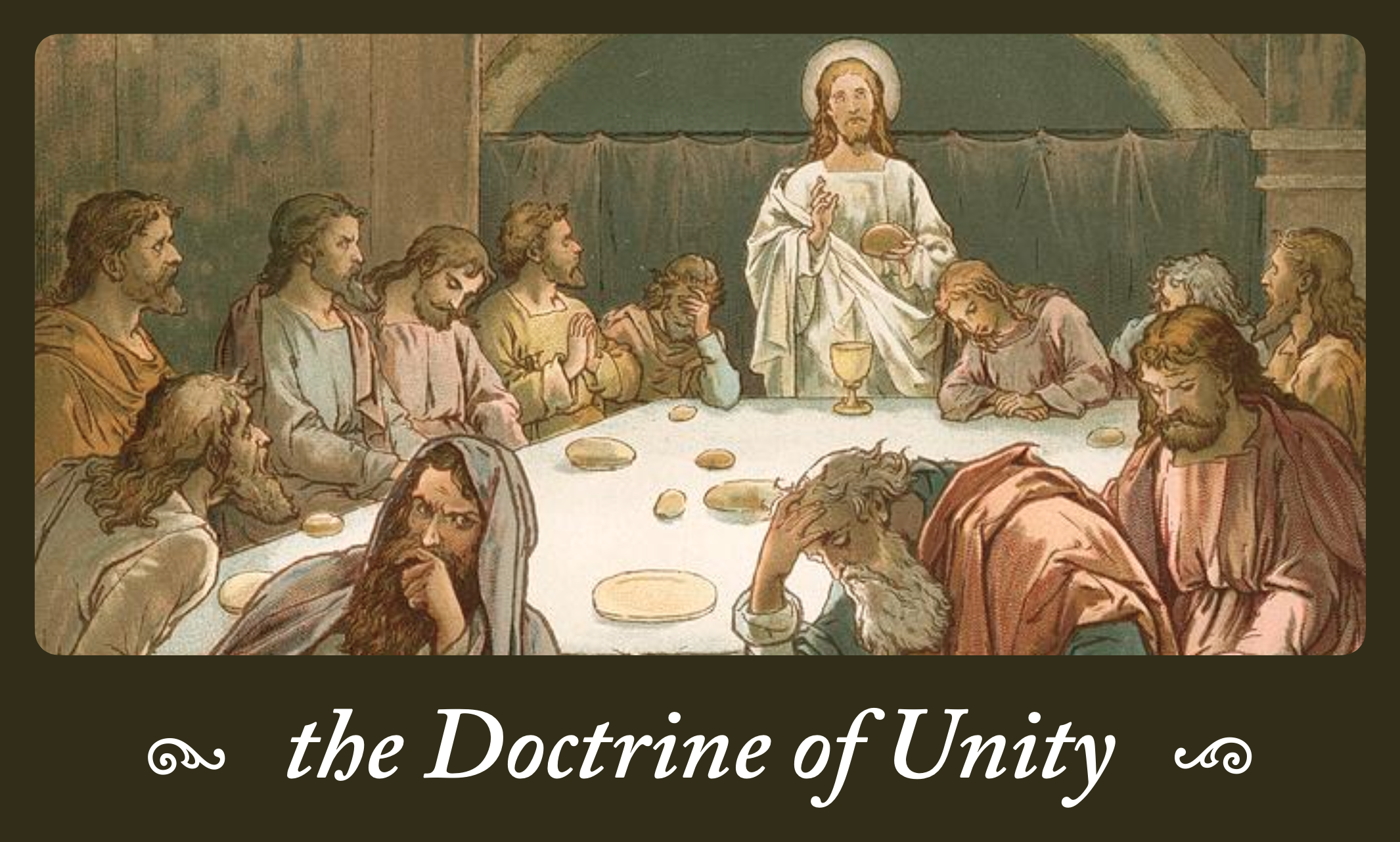

The Doctrine of Unity

The Gospel of John differs from the other gospels in various ways, but one significant difference is John’s inclusion of the extensive time Jesus spends with His disciples on the night of His betrayal and arrest. This section spans John 13-17, and includes Jesus washing the disciples’ feet, His impending betrayal and Peter’s denial, His promise of the coming of the Holy Spirit and the accompanying revelation that He will be leaving them soon, and a repeated emphasis on the importance of love.

Near the end of this section, Jesus also teaches on the subject of unity:

“I do not ask for these only, but also for those who will believe in Me through their word, that they may all be one, just as You, Father, are in Me, and I in You, that they also may be in Us, so that the world may believe that You have sent Me. The glory that You have given Me I have given to them, that they may be one even as We are one, I in them and You in Me, that they may become perfectly one, so that the world may know that You sent Me and loved them even as You loved Me.”

(John 17.20-23)

Here, near the end of the “High Priestly Prayer”, Jesus prays for unity among His followers. When you think about it, this places followers of Jesus in an interesting position: generally, we pray to God asking Him to answer our prayers; in this instance, it seems remarkable to me that we have the opportunity to answer His. 

Furthermore, the unity that Jesus prays for is not arbitrary—it is both formative and practical. It is formative in the sense that, when followers of Christ are unified, we reflect the very nature of the Triune God who exists in perfect unity while displaying diversity. In other words, practicing and displaying unity forms us into the likeness of God. Additionally, unity is practical in the sense that it leads the world to realize the truth of the identity of Jesus Himself.

I have spent my life in Churches of Christ, a group of autonomous congregations of believers that have historical ties to the American Restoration Movement of the 1800s. This movement sought to strip away man-made traditions and restore the Church that they read about in the pages of the New Testament.

The American Restoration Movement (also called the Stone-Campbell Movement) was, significantly, a unity movement. Although the restoration of the New Testament Church was seen as important in its own right, it was also viewed as a means of bringing unity to a fragmented world of Christian denominations: if Christ-followers of different varieties could all just agree to follow the beliefs and practices described in the New Testament, then the elusive unity among His disciples for which Jesus prayed could finally be achieved. To an extent, it worked, as thousands of people left their respective denominations and linked up with the new movement, wanting to be known only as Christians and recognizing only the authority of the Bible. Alas, the unity did not last. Restoration congregations began to divide in the late 19th century, and in 1906, the U.S. Census recognized a formal division between Churches of Christ and Disciples of Christ.

I am proud of the initial focus on unity among my spiritual ancestors, and saddened by the degree to which that strain of our religious DNA later weakened—in the 20th century, Churches of Christ split and divided over all sorts of doctrinal issues (real or imagined), and a passion for unity was not something for which we were generally known. This is really unfortunate, though, because the reality is that more than just a good idea or a noble goal, unity is a doctrine—it is a clear teaching of Jesus. It is one of the last things He emphasized to His disciples before He went to the cross, and He said that it should be one of their defining characteristics.

More than just a good idea or a noble goal, unity is a doctrine. Share on X

This doesn’t mean that we should ignore all other doctrines for the sake of unity, but I do think that doctrinal disagreements that lead us to break unity with other believers should be at least as clearly taught or as central as the doctrine of unity is.

To put it another way, I want to be obedient to the teachings of Jesus. However, if my desire to properly understand and follow the teachings of Jesus has led me, in practice, to minimize the importance of seeking unity with others who proclaim Jesus as Lord, then it is important for me to realize that I am not actually being obedient. Because unity is a doctrine.

Doctrinal disagreements that lead us to break unity with other Christians should be at least as clearly taught or as central as the doctrine of unity is. Share on X

In this loose series of Scripture Reflections, I am sharing brief thoughts spurred on by my Bible reading. By way of reminder, my goal for these brief posts is two-fold:

(1) To remark on aspects of the biblical text that I find to be of interest that the reader may or may not have thought about previously.

(2) When possible, to point to the work and person of Jesus Christ. I believe the Bible is a unified story that points to Jesus, which means that He is frequently alluded to or foreshadowed in some way throughout the biblical canon.

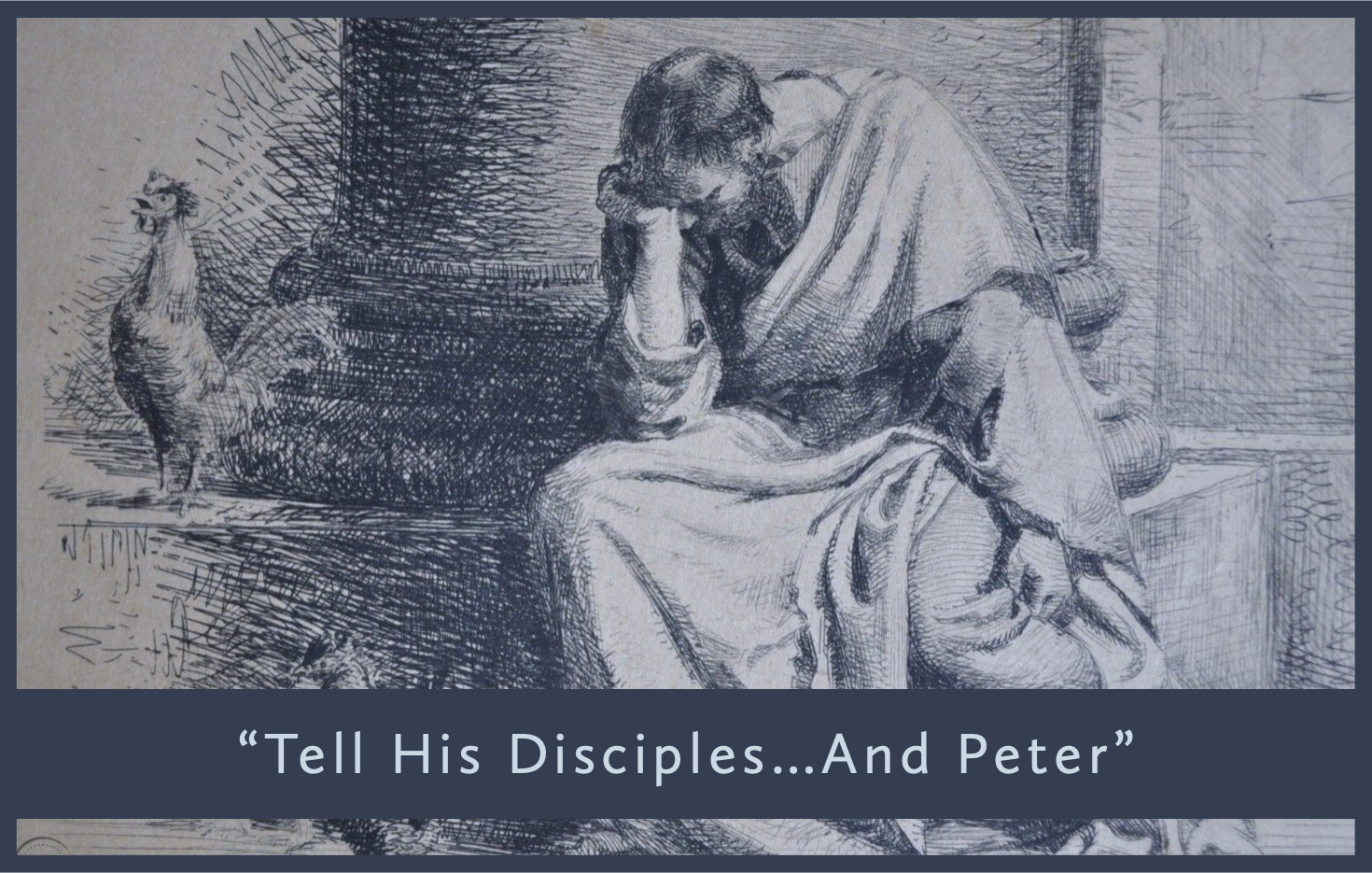
“Tell His Disciples…and Peter”

In the Gospel of Mark, after Jesus has been crucified and buried, and right before the controversial ending of Mark, Mary Magdalene, Mary the mother of James, and Salome come to the tomb of Jesus with spices to anoint Him. They discovered the stone rolled away from the tomb and the tomb itself empty. They see a young man, dressed in a white robe sitting at the side of the tomb and are alarmed.

He tells them:

“Do not be alarmed; you are looking for Jesus of Nazareth, who was crucified. He has been raised; he is not here. Look, there is the place they laid him. But go, tell his disciples and Peter that he is going ahead of you to Galilee; there you will see him, just as he told you.”

(Mark 16.6-7)

Some of this is straightforward enough: remarkably, Jesus has been resurrected from death, and this news needs to be shared with his disciples. Furthermore, this news affirms something that Jesus Himself had told His disciples earlier in Mark 14.28, that He would return from death and go before His disciples to Galilee. Things have happened just as Jesus predicted, and now He calls His disciples to join Him again.

Of course, in that same context in Mark 14, Jesus had also predicted that His disciples would desert Him in the moment of crisis and had specifically told Peter that he would desert Him by denying Him three times (Mark 14.29-31). And that had also come to pass (Mark 14.66-72).

The different gospel accounts (including Mark) are quite clear that Peter is devastated by his denial of Jesus once he really comes to grips with what he has done. I can imagine that the shame and heartache he felt on Thursday night following his denials had only continued and intensified when Jesus was subsequently scourged, crucified, and buried. Peter had been willing to kill for Jesus in the Garden of Gethsemane, but wasn’t willing to die for Him; He had let down His Lord and teacher. I wonder if he even considered himself a disciple anymore.

The messenger at the tomb seems perceptive of all of this. “Go tell His disciples,” he says, “and Peter.” Perhaps Peter is separate because he is no longer one of the disciples, or perhaps it is just a repetition of what happened on the night of Jesus’ betrayal and arrest. Then, it was predicted that all of the disciples would desert Jesus, but Peter is singled out as the one who will deny Him three times. Now, all the disciples are invited to meet the resurrected Christ, but Peter, the one who failed so spectacularly, is singled out with a special invitation.

As one commentator states:

“Why do you suppose the angel singled out Peter as one who was particularly to be told this message? It was done because just three days prior to this, Peter had denied that he had had any association with the Lord. This underscored the fact that, although Peter had rejected Jesus, Jesus had not rejected him.

The same was true of all the disciples. On the night of Jesus’ betrayal, the other apostles did basically what Peter did. All the rest forsook Him and refused to stand by Him. They left and fled in fear for their own lives. But on the heels of the resurrection is the affirmation that though the disciples had abandoned Him, He was not abandoning them.… What they had thought was over and done with, a thing broken, too broken to mend, was still very much alive.”[1]

I imagine that being singled out on the night of Jesus’ betrayal was awkward and awful for Peter. But now, to specifically be included in the invitation to meet the resurrected Christ? That must have been so reassuring: despite Peter’s past failures, Jesus still wanted to see him.


As of the time this article was published, yesterday was Easter, the church’s celebration of the events of Mark 16. Christians around the world proclaim the message that the women at the tomb were told to share. It is a day of joy, celebration, and hope: in the midst of a world plagued by Sin and Death, the resurrection reminds us that Death does not get the last word, and will indeed be defeated someday. There is a sense of triumphalism surrounding Easter, and that is appropriate because Jesus the Christ certainly triumphed.

But there are many, many out there who perhaps feel on Easter similarly to how Peter felt on the Sunday of the Resurrection. There are many who have followed Jesus at one point, but perhaps deserted Him when things got too difficult. Maybe they denied Him to their peers, or quit following Him because they feared death—if not literal death, the death to self that true discipleship requires. For those in this category, Easter possibly brings feelings of guilt and shame similar to those experienced by Peter.

Such feelings are not necessary, however, because the Good News of the empty tomb is for disciples…and Peter. If you have failed and, perhaps, failed so spectacularly that you feel that there is no place for you among followers of Jesus any longer—be reassured. The invitation to meet and follow the resurrected Christ is for you, too. Just like Peter.

If you have failed so spectacularly that you feel that there is no place for you among followers of Jesus any longer—be reassured. The invitation to meet and follow the resurrected Christ is for you, too. Just like Peter. Share on X

In this loose series of Scripture Reflections, I am sharing brief thoughts spurred on by my Bible reading. By way of reminder, my goal for these brief posts is two-fold:

(1) To remark on aspects of the biblical text that I find to be of interest that the reader may or may not have thought about previously.

(2) When possible, to point ahead to the work and person of Jesus Christ. I believe the Bible is a unified story that points to Jesus, which means that He is frequently alluded to or foreshadowed in some way throughout the biblical canon.


[1] Joe D. Schubert, Mark: Introduce Us to the Master: Expository Studies in the Gospel of Mark (Searcy, AR: Resource Publications, 1987): 306.

Seeking a Homeland

In the midst of a discussion of various heroes of faith, the Hebrew writer says:

These all died in faith, not having received the things promised, but having seen them and greeted them from afar, and having acknowledged that they were strangers and exiles on the earth. For people who speak thus make it clear that they are seeking a homeland. If they had been thinking of that land from which they had gone out, they would have had opportunity to return. But as it is, they desire a better country, that is, a heavenly one. Therefore God is not ashamed to be called their God, for he has prepared for them a city.

(Hebrews 11.13-16)

Above, these people of faith are described as “seeking a homeland.” This was true in a physical sense for Abraham and Sarah, who left their homeland to go to the place which God directed them, but in a deeper sense, it is true (or should be true) of all of God’s people.

The older I get, the more keenly aware I am that this world, which was created “good” but was broken and cursed by the plague of sin, is not a suitable homeland for me. I yearn for a better, kinder, more whole place. And this is a normal feeling (or at least, it should be): the New Testament in several places indicates that Christians are sojourners who are out of place in this world, and citizens of another (John 15.18-19, John 17.16, Philippians 3.20, 1 Peter 2.11). As Christians, we long for Jesus to return, mend the brokenness in His good creation, and bring about cosmic redemption.

Unfortunately, I think our modern world—with all of its distractions and comforts—frequently makes Christians forget that this isn’t, in fact, our homeland. We obsess over the things of this life and arrange our lives based on worldly priorities. Then, we aren’t content with those lives and, what’s more, we’re surprised that we aren’t content, missing the point that we’re not supposed to be content and at peace with a life that is so anchored to this world in its current, cursed state.

And the irony is, by being so focused on this world, we don’t actually benefit the world much at all. In Mere Christianity, C.S. Lewis said:

If you read history you will find that the Christians who did most for the present world were precisely those who thought most of the next. It is since Christians have largely ceased to think of the other world that they have become so ineffective in this.

We desperately need to recover our sense of being pilgrims in this world and longing for the next. It enables us to have contentment in our lives, and to better benefit those around us. Remember, we are people who are “seeking a homeland.”


In this loose series of Scripture Reflections, I am sharing brief thoughts spurred on by my Bible reading. By way of reminder, my goal for these brief posts is two-fold:

(1) To remark on aspects of the biblical text that I find to be of interest that the reader may or may not have thought about previously.

(2) When possible, to point ahead to the work and person of Jesus Christ. I believe the Bible is a unified story that points to Jesus, which means that He is frequently alluded to or foreshadowed in some way throughout the biblical canon.

Jethro’s Wise Advice

In Exodus 18, Moses has led the people of Israel out of Egypt. He has shown God’s power through the plagues on Pharaoh and the Egyptians, and through him, God has revealed His supremacy over the pantheon of Egyptian gods. Now, Moses is leading the nomadic nation of Israel through the wilderness.

Moses receives a visit from Jethro, his father-in-law, and tells him of all the amazing things that the LORD has done. Jethro is amazed, rejoicing over the kindness that God had shown to the Israelites, and praising His name: “Now I know that the LORD is greater than all gods” (Exodus 18.11).

The next day, Jethro witnesses Moses serving as a judge among the people: from morning to evening, people come before Moses bringing disputes before him, seeking a judgment or resolution. Jethro is troubled by this:

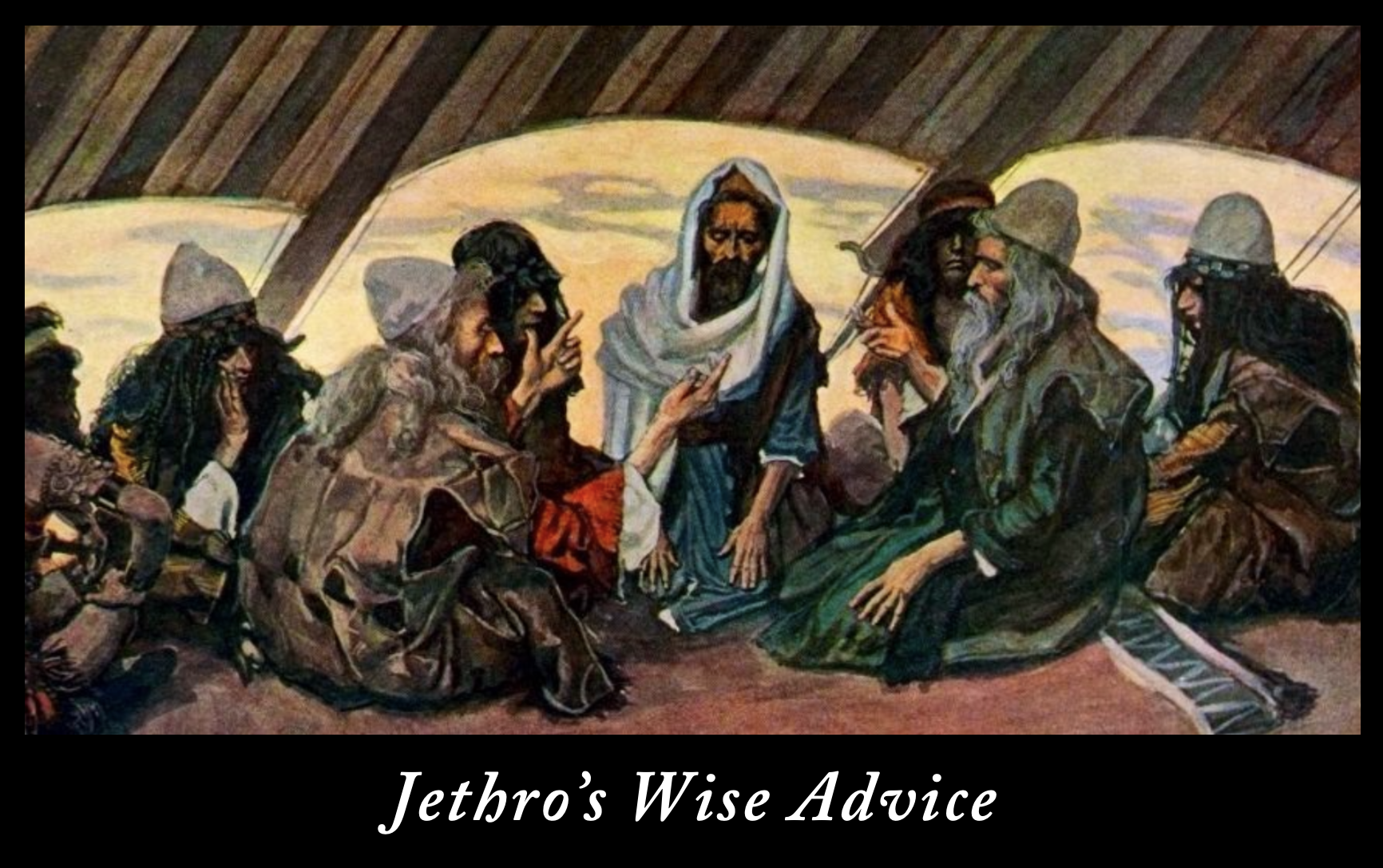
But Moses’ father-in-law said to him, “The thing you are doing is not right; you will surely wear yourself out, and these people as well. For the task is too heavy for you; you cannot do it alone. Now listen to me. I will give you counsel, and God be with you! You represent the people before God: you bring the disputes before God, and enjoin upon them the laws and the teachings, and make known to them the way they are to go and the practices they are to follow. You shall also seek out from among all the people capable men who fear God, trustworthy men who spurn ill-gotten gain. Set these over them as chiefs of thousands, hundreds, fifties, and tens, and let them judge the people at all times. Have them bring every major dispute to you, but let them decide every minor dispute themselves. Make it easier for yourself by letting them share the burden with you. If you do this—and God so commands you—you will be able to bear up; and all these people too will go home unwearied.”

Moses heeded his father-in-law and did just as he had said. Moses chose capable men out of all Israel, and appointed them heads over the people—chiefs of thousands, hundreds, fifties, and tens; and they judged the people at all times: the difficult matters they would bring to Moses, and all the minor matters they would decide themselves. Then Moses bade his father-in-law farewell, and he went his way to his own land.

(Exodus 18.17-27)

Jethro’s counsel reflects the wisdom and experience of an older man. Moses is certainly a capable leader, but trying to adjudicate every dispute himself is unsustainable and will ultimately result in burnout. Instead, Jethro suggests, Moses needs to assemble a team of others who can help share the load of handling these matters. Moses himself will continue on as a sort of Supreme Court to handle the most important cases, while others can handle the vast majority of easier and less significant disputes.

In addition to being wise advice that any successful leadership guru would approve of, this also reflects the practice of Jesus and the designed structure of His church:

  • Although Jesus is, ultimately, the Judge of the world, He did not take it upon Himself to try to sort out every dispute (Luke 12.14).
  • Jesus spent the bulk of His ministry not just doing everything Himself, but training the Twelve so that they could lead after Him.
  • The leadership of the church is not entrusted to one person: instead, there are apostles, prophets, evangelists, shepherds, and teachers who share in that work (Ephesians 4.11ff). Furthermore, the church is the Body of Christ, and all members of the body have important roles to play (Romans 12).
  • In discussions of Elders and Deacons (1 Timothy 3; Titus 1), there is never the hint of one person filling these roles, but always on a plurality or group of individuals.

Indeed, the basic advice of Jethro for Moses to “share the burden” with others (Exodus 18.22), reflects these same realities, as we are instructed to cast our burdens upon God (1 Peter 5.7), and for brothers and sisters in Christ to mutually share their burdens because doing so fulfills the law of Christ (Galatians 6.2). In other words, this is more than good advice: it is very much God’s design and will.

All of us have a variety of burdens in life—responsibilities, struggles, challenges, etc.—but God does not intend that we carry these burdens alone. Listen to Jethro: share the burden.

All of us have a variety of burdens in life—responsibilities, struggles, challenges, etc.—but God does not intend that we carry these burdens alone. Share on X

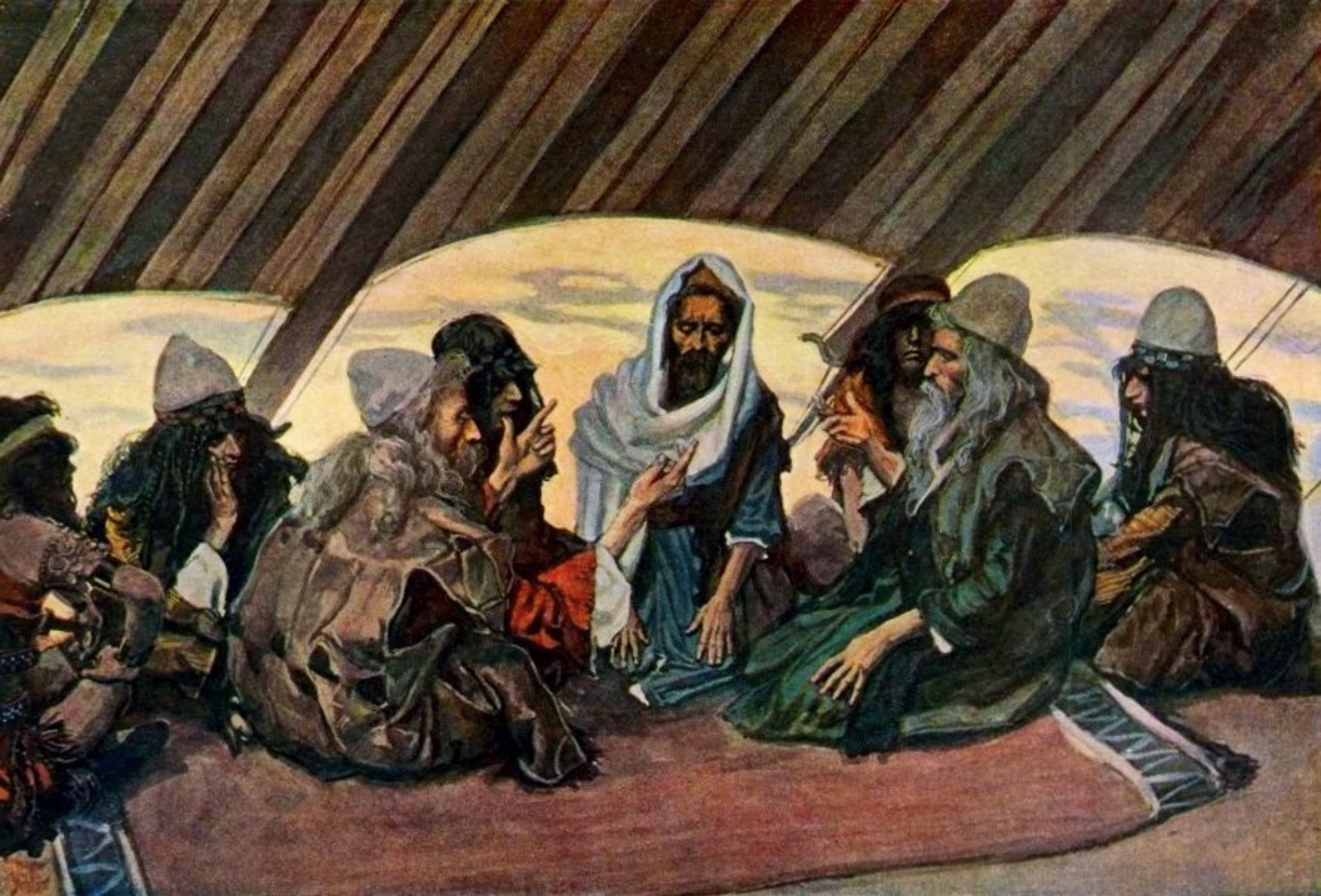
Jethro and Moses, watercolor circa 1900 by James Tissot


In this loose series of Scripture Reflections, I am sharing brief thoughts spurred on by my Bible reading this year. By way of reminder, my goal for these brief posts is two-fold:

(1) To remark on aspects of the biblical text that I find to be of interest that the reader may or may not have thought about previously.

(2) When possible, to point ahead to the work and person of Jesus Christ. I believe the Bible is a unified story that points to Jesus, which means that He is frequently alluded to or foreshadowed in some way throughout the biblical canon.

« Older posts Newer posts »

© 2026 The Doc File

Theme by Anders Noren — Up ↑