The online journal of Luke Dockery

Category: Bible Study (Page 11 of 40)

The Beatitudes: Kingdom Character

I don’t remember what the driving force was at the time, but about seven years ago, I got into the Sermon on the Mount. I mean, really got into it. I taught it to my teenagers. I taught an adult Bible class on it. I spoke in a summer series on it. I published a book on it. I directed a youth conference on it. It was pretty much an obsession—I had come to realize that this was Jesus’s Kingdom Manifesto, where He declared what living in His kingdom is all about, to those who desire to be a part of that kingdom.[1] As someone who desired to be a part of that kingdom, it seemed really important to me that I take Jesus’s words very seriously.

What I found was that, as I really got into the Sermon on the Mount, it actually really got into me. Not overnight, but gradually, as I read it and taught it more and more, it began to change me from the inside out. I began to pray the Lord’s Prayer more. The way I interacted with people online began to change—I was not as quick to rush in to straighten someone out, or as defensive when someone was critical of me. I tried to be more generous in my judgments of other people. My views on how Christians are to interact with and influence the world changed significantly. It’s not an overstatement to say that the Sermon on the Mount gradually became the default lens through which I viewed the world.[2]

What I found was that, as I really got into the Sermon on the Mount, it actually really got into me. Share on X

With all that in mind, I’d like to do a series on the first part of the Sermon on the Mount, the sayings that Jesus presents known as the Beatitudes.


Our English word “beatitude” comes from beatitudo, which is the Latin equivalent of the Greek word μακαριος/makarios, a word that means “happy” or “blessed,” and this is how all of the Beatitudes start: “Blessed are the _________.”[3] We live in a world where people desperately do anything they can think of in order to be happy, but what Jesus is talking about here is not a pleasant emotional response that comes to us based on outward circumstances. Instead, the sense of this word is something like, “God is pleased with” or “God’s favor rests upon” the people who possess the characteristics that Jesus goes on to describe.[4] Jesus is telling us what a good life really looks like from God’s perspective.

In the Sermon on the Mount, Jesus is setting up an alternative community, where people live by values and principles that are dramatically different from those of the world, and we clearly see this in the Beatitudes. First, the people who Jesus describes as being happy or blessed are not the people who the world would describe in that way.[5] Jesus redefines what blessedness is and provides an alternative set of values for His followers. Also, the word μακαριοι/makarioi that we have already discussed that Jesus uses repeatedly here is plural. This means that Jesus’ beatitudes are not directed at individuals, but are to be the practices of the community that Jesus is establishing.[6] So Jesus’s beatitudes will describe the same group of people in multiple ways: God’s kingdom, an alternative community made up of His disciples.

Matthew’s record of these beatitudes bears some similarity to the shorter beatitudes recorded in Luke’s Sermon on the Plain:
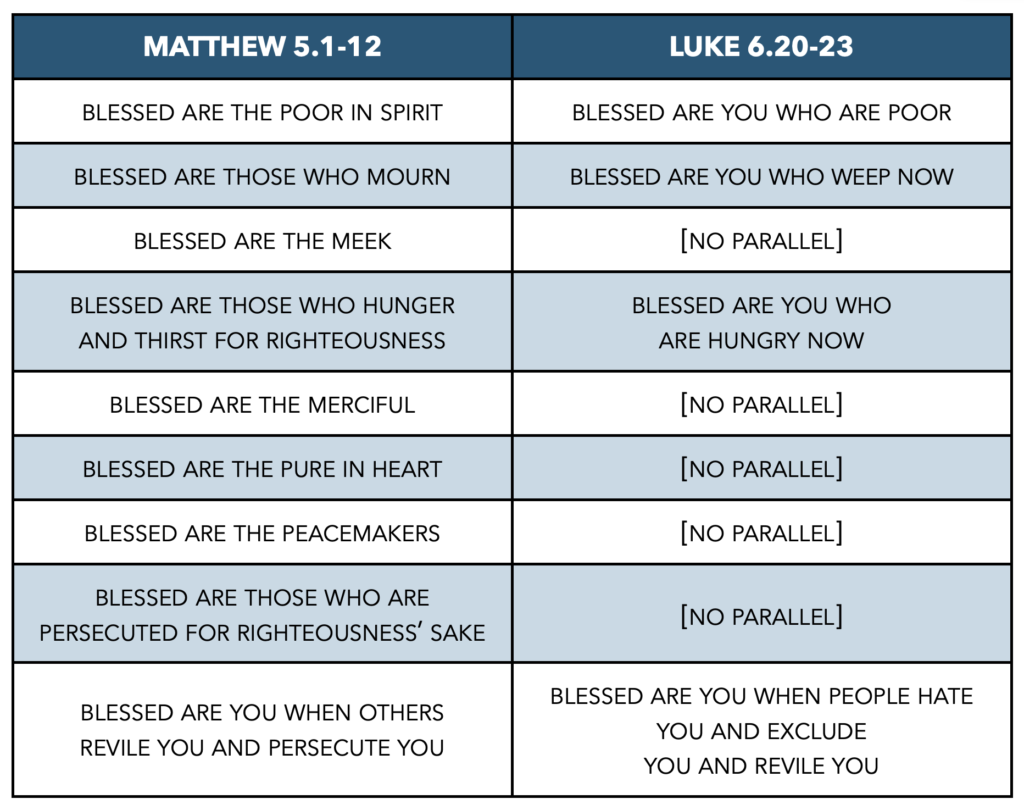
Some biblical scholars have made a big deal about the differences between Luke’s beatitudes and Matthew’s, suggesting that Luke focuses on physical characteristics (poor, hungry, etc.), while Matthew emphasizes spiritual characteristics instead (poor in spirit, hunger for righteousness, etc.). These interpreters sometimes “spiritualize” Matthew’s beatitudes so much that they no longer have any connection to the historical context in which Jesus is speaking.[7]

I don’t think it is necessary to make such a sharp distinction, though. It seems unlikely that Jesus would present two different, unconnected sets of beatitudes, one focused on physical characteristics and the other on spiritual characteristics. What makes more sense is that in both places Jesus presents characteristics of those who God calls “blessed”, but in Matthew, He emphasizes that certain physical characteristics have spiritual implications.

With that in mind, we want to be balanced as we look at these traits. While it is true that the Sermon on the Mount doesn’t portray Jesus as a political revolutionary who is advocating for social or economic upheaval, He does address social and economic problems that are a result of the political realities of His day. In a real sense, Jesus invites His audience (including us) to imagine a different sort of world: the kingdom of God. And God’s kingdom is an upside-down kingdom, which reverses the conditions of people where the poor, hungry, and persecuted are called “blessed.”[8]

I hope you’ll read along as we examine the Beatitudes one by one.

Jesus invites His audience—including us—to imagine a different sort of world: the kingdom of God. Share on X
If you enjoyed this post, you might enjoy my book on the Sermon on the Mount, Counter Culture: A Study of the Sermon on the Mount. 

Although this book was written specifically as an aid to teaching the Sermon on the Mount to junior high and high school students, it is also useful for personal Bible study, and the depth of the material makes it a great resource for adult Bible classes.


[1] J. Oswald Dykes, The Manifesto of the King: An Exposition of the Sermon on the Mount (London, J. Lisbet, 1881).

[2] In many ways, this seems providential to me, in light of all that has gone on in the world over the last several years: the rise of Trump, the COVID-19 pandemic, Black Lives Matter and racial unrest, QAnon, the January 6 uprising, increased political polarization; the list goes on and on. I cannot pretend that I responded perfectly to all of these developments, but I truly believe that my deep immersion in the Sermon on the Mount helped me to have a kingdom perspective on these events that saved me from a lot of unhealthy responses.

[3] Jack P. Lewis, The Gospel According to Matthew, Part I, The Living Word Commentary (Austin, TX: Sweet Publishing, 1976), 79.

[4] Warren Carter, “Power and Identities: The Contexts of Matthew’s Sermon on the Mount,” in Preaching the Sermon on the Mount: The World It Imagines, ed. David Fleer and Dave Bland (St. Louis: Chalice Press, 2007), 17.

[5] J.W. McGarvey, Matthew and Mark, The New Testament Commentary (Delight, AR: Gospel Light Publishing Company, 1875), 51: “The world’s conception of the man who is superlatively blessed has always been the reverse of what is here taught.” Randy Harris, Living Jesus: Doing What Jesus Says in the Sermon on the Mount (Abilene, TX, Leafwood, 2012), 31: “Jesus’ idea of the blessed life and our idea of the blessed life have almost nothing in common.”

[6] Carter, 17.

[7] Francis Wright Beare, The Gospel According to Matthew: A Commentary (Oxford: Basil Blackwell, 1981), 133, is a good example of someone who emphasizes the supposed distinctions between Matthew and Luke in the Beatitudes. McGarvey, 51, spiritualizes Matthew’s Beatitudes, to where, for example, “poor in spirit” has nothing to do with actual poverty.

[8] Beare, 127; Larry Chouinard, Matthew, The College Press NIV Commentary (Joplin, MO, College Press, 1997), 94.


Three Gardens

It’s a well-known story: Jesus is in the Garden of Gethsemane on the evening He was betrayed. He is there with Peter, James, and John, who He asks to watch with Him, but they struggle to understand the significance of the moment and fall asleep. Meanwhile, Jesus is praying earnestly as He anticipates what is about to happen to Him:

Then Jesus went with them to a place called Gethsemane, and he said to his disciples, “Sit here, while I go over there and pray.” And taking with him Peter and the two sons of Zebedee, he began to be sorrowful and troubled. Then he said to them, “My soul is very sorrowful, even to death; remain here, and watch with me.” And going a little farther he fell on his face and prayed, saying, “My Father, if it be possible, let this cup pass from me; nevertheless, not as I will, but as you will.” And he came to the disciples and found them sleeping. And he said to Peter, “So, could you not watch with me one hour? Watch and pray that you may not enter into temptation. The spirit indeed is willing, but the flesh is weak.” Again, for the second time, he went away and prayed, “My Father, if this cannot pass unless I drink it, your will be done.” And again he came and found them sleeping, for their eyes were heavy. So, leaving them again, he went away and prayed for the third time, saying the same words again. Then he came to the disciples and said to them, “Sleep and take your rest later on. See, the hour is at hand, and the Son of Man is betrayed into the hands of sinners. Rise, let us be going; see, my betrayer is at hand.”

(Matthew 26.36-46)

“Nevertheless not as I will, but as You will.”

Jesus has a desire, a preference, a will: He would rather not die on the cross, taking the guilt and shame of all of humanity upon Himself. In His human form, in this willing circumstance of self-limitation, death on the cross doesn’t seem like a good thing. But the Son defers to the Father and will follow His way.

This episode in a garden stands in sharp contrast to an earlier event in another garden, way back at the beginning of the biblical narrative, where we find Adam and Eve in the paradise of Eden. There, the two young humans see something that looks good to them—the fruit of a certain tree. God had already defined it as not good for them, but they decide to follow their own way instead. Disaster ensues.

The failure in the first garden is the source of what becomes a steady and mighty stream of human failures growing over time, and making the success of Jesus in His garden crucible all the more impressive. Based on His submission to the Father’s will, the sinless Jesus is crucified. He is then vindicated in His resurrection and ascends upon high where He is seated at the right hand of the Father as Lord, and He will come again as Judge. And when He does, the dwelling place of God will be with people (Revelation 21.3), in a third garden, a garden-city: a holy city with high walls, open gates, the river of the water of life, and the tree of life (Revelation 21-22).

There, made possible by the victory of Christ, sin and death will be no more, and neither will be the selfish pursuit of our own will. We will finally resemble the Last Adam, instead of the First, following the Father’s way, instead of our own.

One day, we will finally resemble the Last Adam instead of the first, following the Father’s way, instead of our own. Share on X

In this loose series of Scripture Reflections, I am sharing brief thoughts spurred on by my Bible reading. By way of reminder, my goal for these brief posts is two-fold:

(1) To remark on aspects of the biblical text that I find to be of interest that the reader may or may not have thought about previously.

(2) When possible, to point to the work and person of Jesus Christ. I believe the Bible is a unified story that points to Jesus, which means that He is frequently alluded to or foreshadowed in some way throughout the biblical canon.

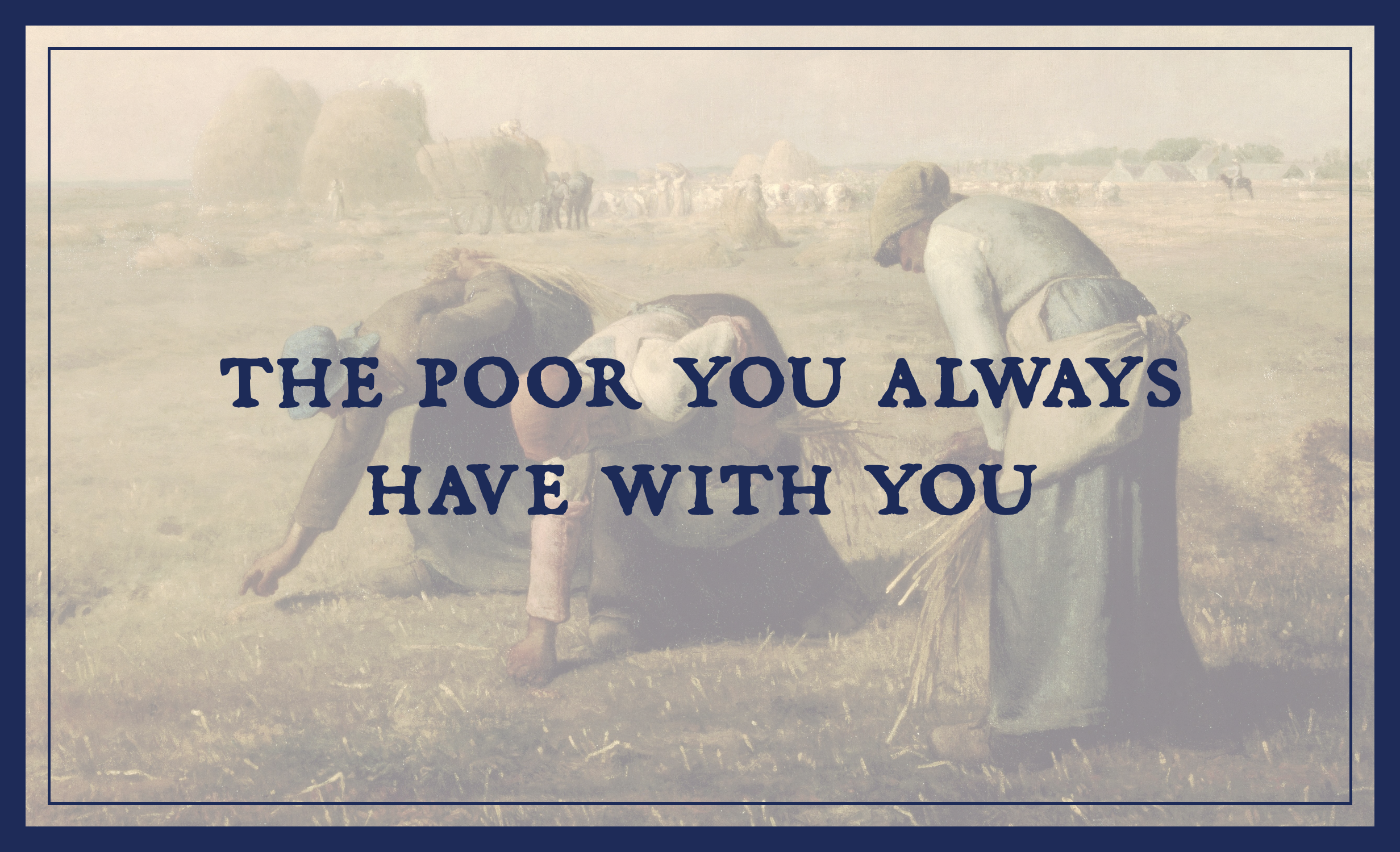
The Poor You Always Have With You

In a recent reading of Deuteronomy, I was struck by the following passage, specifically because of how it connected to other passages in the New Testament:

If among you, one of your brothers should become poor, in any of your towns within your land that the LORD your God is giving you, you shall not harden your heart or shut your hand against your poor brother, but you shall open your hand to him and lend him sufficient for his need, whatever it may be.

Take care lest there be an unworthy thought in your heart and you say, “The seventh year, the year of release is near,” and your eye look grudgingly on your poor brother, and you give him nothing, and he cry to the LORD against you, and you be guilty of sin. You shall give to him freely, and your heart shall not be grudging when you give to him, because for this the LORD your God will bless you in all your work in all that you undertake.

For there will never cease to be poor in the land. Therefore I command you, “You shall open wide your hand to your brother, to the needy and to the poor, in your land.”

(Deuteronomy 15.7-11)

One of the repeated themes of Torah is God’s concern for those on the margins of society, especially the poor, widows, orphans, and immigrants. Out of that concern, God clearly and repeatedly shares His expectation that His people will seek to take care of the poor in their land. This is to be accomplished in many ways, from the practice of gleaning, to levirate marriage, to sabbath years where debts are forgiven, to the general practice of prohibiting interest when loans are given.

But it was the beginning of the last verse that caught my attention—“For there will never cease to be poor in the land”—because of its similarity to something Jesus says in the Gospels. Matthew and John seem to recount versions of the same incident.[1] Jesus is eating a meal in Bethany when a woman (in John’s account, she is identified as Mary, the sister of Martha and Lazarus) comes in and anoints Jesus with expensive ointment, and wipes His feet with her hair.

The disciples see this and respond indignantly, suggesting how wasteful this was—the money spent for this ointment could have been given to the poor instead.[2] Jesus tells His disciples to leave her alone, praising the beautiful and extravagant thing that Mary has done for Him: “For the poor you always have with you, but you do not always have Me.”

I’ve heard these passages discussed before in a way that almost seems to make Jesus uncaring toward the poor, i.e., “You can help the poor anytime, so it’s really not a big deal,” but I think that really misses the mark. Jesus is talking here in terms of urgency, rather than importance: He is about to be crucified, and there won’t be a later opportunity to do what Mary has done. It’s not that helping the poor is unimportant; it’s just that the only opportunity to do so isn’t right now, unlike the opportunity to anoint Jesus.

This is further underscored when you realize how closely Jesus’ words seem to be based directly on this passage in Deuteronomy. Poverty is a real, persistent problem, and this side of eternity, there will always be people in need. This shouldn’t cause us to despair or somehow make us less inclined to help. Rather, the opposite is true: the ever-presence of the needy should make us ever-ready to help. It may not always present as an urgent issue (because you will have constant, repeated opportunities to help those mired in poverty), but it is certainly important: God’s heart for the needy is revealed repeatedly in the Torah, and Jesus affirms the same idea Himself. The poor will always be with us, so God’s people should always be for them.

The ever-presence of the needy should make us ever-ready to help. Share on X The poor will always be *with* us, so God’s people should always be *for* them. Share on X

In this loose series of Scripture Reflections, I am sharing brief thoughts spurred on by my Bible reading. By way of reminder, my goal for these brief posts is two-fold:

(1) To remark on aspects of the biblical text that I find to be of interest that the reader may or may not have thought about previously.

(2) When possible, to point to the work and person of Jesus Christ. I believe the Bible is a unified story that points to Jesus, which means that He is frequently alluded to or foreshadowed in some way throughout the biblical canon.


[1] There is some disagreement about whether or not Matthew 26.6-13 and John 12.1-8 recount the same incident. There are differences: Matthew locates the event at the home of Simon the Leper, while John implies (but does not state) that the location is the home of Mary, Martha, and Lazarus. Furthermore, John identifies Mary as the one who anoints Jesus’ with perfume, while Matthew leaves the anointer unnamed. In Matthew, Jesus’ head is anointed, while in John, it is His feet. There are other, small differences as well. Nevertheless, the overall similarity between the two incidents is striking, and the differences can be accounted for in plausible ways. For the sake of this post, I will just treat it as one event described in two different Gospels.

[2] John informs us that it was Judas Iscariot who spoke out in criticism, but that his concern was not really for the poor, but rather, his own greed: as the treasurer for the group, he had access to the money bag and used to steal from it. Selling the ointment and giving the money to Jesus—ostensibly to care for the poor—would have benefited the thieving Judas.

New Projects

I have not written as much recently here on The Doc File as I would like, largely because I have been busy with other things:

To this list, most recently I have added a new project: my good friend Kevin Burr and I launched Regnum Media, a publishing house that will produce scholarly-yet-accessible Bible studies that are primarily intended for use in adult Bible classes as well as personal study. Regnum Media will be operating in partnership with the Center for Christian Studies, and will serve as the publishing imprint for CCS. CCS seeks to provide “scholarship for the church,” and has been doing this in excellent fashion already through video teaching modules and a scholarly journal that is released three times per year. We are excited to partner with CCS in this good work.

From the CCS press release about our partnership, here is a quotation from yours truly:

In our years of congregational ministry, both Kevin and I have become keenly aware of the need for quality Bible class resources that are trustworthy, scholarly, and engaging, and it was with this need in mind that Regnum Media was formed.

Regnum is the Latin word for ‘reign’ or ‘rule,’ and from the beginning it has been our goal to work for the good of the Kingdom, using our humble efforts to help the reign of God come more fully on earth as it is in heaven. We believe that quality biblical teaching that leads to discipleship in the local church is a key ingredient of that, and we are thrilled with the opportunity to partner with the good work that CCS is already doing in this regard.

We are planning to release four titles in 2023, including a version of my Ecclesiastes material specifically geared toward adults. You can follow our Facebook page to keep up to date on news and releases.

I still remain fully committed to all of the various roles and projects listed above, and intend to keep writing in this space as well. There are busy days ahead, but my hope is that God can use my humble efforts in the advancement of His kingdom.

« Older posts Newer posts »

© 2026 The Doc File

Theme by Anders Noren — Up ↑